Help for Sciatica – Dr. Benjamin Streufert on Tampa Bay’s Morning Blend
If you’re experiencing shooting pain down your leg, numbness, or discomfort in your lower back, it could be sciatica. In this recent Morning Blend interview, Dr. Ben Streufert from Florida Orthopaedic Institute share what causes sciatica, how to recognize the symptoms, and the treatment options available to help you feel like yourself again.
From non-surgical approaches to specialized care, there are solutions that can get you back to doing what you love without constant pain. If you or someone you know is struggling with sciatica, don’t wait to seek care. Relief is possible.
Read more on: Tampa Bay’s Morning Blend
Roxanne: I’m with Dr. Ben Streufert at Florida Orthopaedic Institute. I’m so happy to be here and talk about our interesting medical topics. As always, great to see you, doctor.
Dr. Streufert: Great to see you as well, Roxanne.
Roxanne: We’re talking about sciatica today and really delving into this. And so I just want to start big picture for those who aren’t familiar, maybe I’m sure they’ve heard the term, but what is sciatica?
Dr. Streufert: Well, sciatica is a very, very common thing that many adults will experience in their life.
And it can sometimes be confusing to hear someone say, oh, it’s sciatica. It’s just my back pain again. But sciatica, I think in many people’s minds is actually when pain shoots into the leg or the legs, usually from a pinched nerve from the back.
But some people say, oh, it’s just in my back. Others say it’s down my leg. Most of us in spine surgery and treatment of spine problems would say that it’s a pinched nerve or even radiculopathy to use a technical term, usually sending pain, numbness and weakness into the leg.
Roxanne: And is it unilateral, bilateral? It can be either?
Dr. Streufert: Yeah, it’s a very good question. It can be both, meaning bilateral or unilateral, just on the left or the right. Most commonly, I would say it’s usually on one side or the other, but again, can be both.
Roxanne: That makes sense. I love that you brought a prop with us. So we can definitely see how that works.
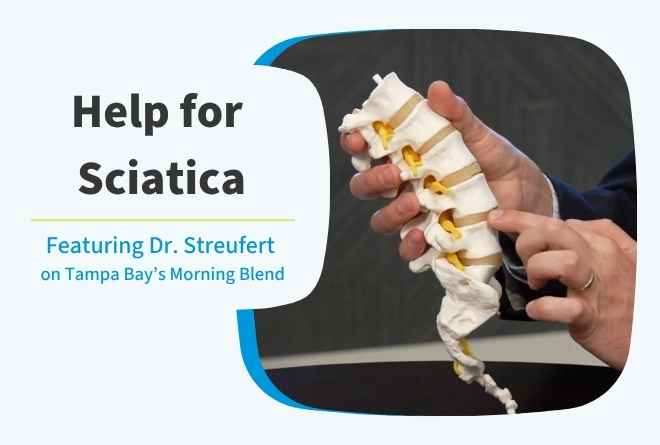
Dr. Streufert: We’re looking at part of your spine there. And so this is something we’re going to feel symptoms. If you have sciatica, you’re going to have varying symptoms.
Could be severe, could be just coming on. You’re exactly right. And this spine model is going to be useful to kind of understand because the picture is usually worth a thousand words for this.
So the spine is oriented in a way that allows some flexibility. So between the spinal bones, which are these kind of lighter structures here, and the more tan structure, that’s the disc space that allows the flexibility that you get in your spine in twisting and bending forward. But sometimes that flexibility, that flexible part, the disc, can actually rupture or what we sometimes say is herniate.
Imagine a jelly donut that has the jelly inside. And if you squish on the jelly donut, it can kind of shoot some of the jelly out towards the back. And sometimes that herniation irritates the spinal nerves, giving you pain, usually again, into the legs.
And the severity of the symptoms are exactly what you described. They can run from just tingling that might go down the leg or numbness in the foot or the toes even, to really pretty severe pain that radiates and can be debilitating in many cases.
Roxanne: Sure. Okay, let’s talk about treatments. Once it’s been identified and you identify per symptom with some sort of x-ray, is that how you identify it?
Dr. Streufert: Yeah, that’s a big component. So we usually do take some x-rays to kind of identify the disc spaces in the spinal bones to look at more of the structure of the spine.
That’s part of it, but a physical exam and even really just a description of hearing someone’s symptoms often takes us a long way because if someone says, you know, ouch, it hurts towards my hip or into my buttock, that might be indicative maybe of a different sort of situation than if someone says it hurts all the way down my leg and I’m even having trouble moving my leg or my foot.
Roxanne: That’s when you’re talking about getting into those severity of symptoms, which again, you want to have treatments that also have a range. You can do something more conservative or you could actually go for surgery.
Dr. Streufert: That’s exactly right. So the range of treatments kind of matches the severity of the symptoms. So initial treatment for someone who has pain radiating to their leg or sciatica would really look like medicines that can help relieve pain symptoms, calm down nerve irritation.
Activities can be useful as well, not just formal physical therapy, but home exercises and stretching exercises. You know, after medicine and physical therapy, sometimes time helps. You know, most of these symptoms do get better with time and then when they don’t or when there’s more concerning sets of symptoms like weakness into the foot or the legs or difficulty walking, then we really accelerate things a lot further by, you know, more diagnostic tests such as MRIs and maybe more invasive treatments such as injections or even surgeries.
Roxanne: The bottom line is if you’re in pain, you don’t want to just not do anything about it. The wait and see approach, you do that a little bit at the beginning, but then you have to take some action and we’ve got the information for you on the screen so you can feel better. Give Florida Orthopedic Institute a call.
There’s the number, the website, and you’ll meet wonderful doctors like we’ve talked with Dr. Ben Streufert today. Appreciate your time.
Dr. Streufert: Thank you so much, Roxanne.
June 12, 2026