Help for Chronic Shoulder Pain – Dr. Michael Elsenbeck on Tampa Bay’s Morning Blend
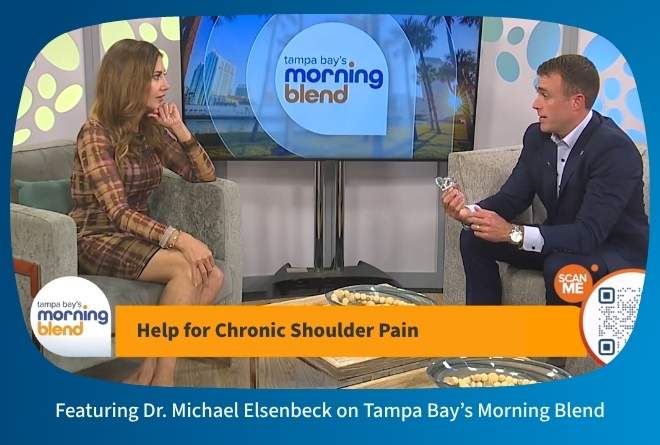
When shoulder pain limits your ability to move, work, and enjoy life, advanced treatment options matter. Dr. Elsenbeck and Florida Orthopaedic Institute are leading the way with Mako Shoulder robotic-assisted replacement for eligible patients.
Read more on Tampa Bay’s Morning Blend.
Roxanne: Have you been living with shoulder pain, maybe from an old injury that’s limiting movement in your life? Well, there is help. Florida Orthopaedic Institute has advanced robotic-assisted technology that can really be life-changing. It’s so good to hear. And Dr. Michael Elsenbeck joins me today. So good to have you, thanks for being here, Doctor.
Dr. Elsenbeck: Thank you, Roxanne. Thanks for having me. I’m really excited to be here and tell the Tampa Bay area this new technology that we have for patients to make shoulders better for them.
Roxanne: Ah, that’s wonderful to hear. Okay, so I’ve been hearing about this Mako shoulder, and this is the robotic advancements to surgery. Doesn’t involve sharks, right?
Dr. Elsenbeck: No.
Roxanne: That’s what I think of.
Dr. Elsenbeck: No, we are right next to the Gulf Coast, but it’s not involving any sharks. So what Mako is, it’s a robot-assisted procedure that allows surgeons to perform a shoulder replacement with better accuracy. Okay, so when shoulder replacements have been around for a while, and nothing new is planning shoulder replacements.
So when patients get a shoulder, the first thing that happens, they get a CT scan. This goes into a planning software that basically allows the surgeon to see exactly what the patient’s anatomy is, and it allows them to plan what size implant they’re gonna use, how the implant’s gonna sit in the patient and the lengths of the screws. So that’s not new.
What Mako is, is it takes that plan and it allows you to better implement it in the operating room. So I brought with me, this is a model here of a reverse shoulder implant. And really the success of this operation is predicated upon successful implantation of what we call the glenosphere.
Roxanne: Okay.
Dr. Elsenbeck: So what we do when I’m planning solvers, let’s say in 30 years, you know, you need a shoulder replacement, you come and see me. The first thing I do.
Roxanne: Okay, I’m coming to you, Doctor.
Dr. Elsenbeck: I’m gonna get a CT scan, okay? And then what that does is it allows me to see your anatomy. I can plan what size sphere we’re gonna use. I can also use the instrumentation to see the length screws. And it allows me to see where that’s going to go.
Now, before Mako, we used to have that plan and we would print it out and we would put it up in the operating room and kind of use our best guess to see, you know, how well are we executing that plan?
Roxanne: Sure
Dr. Elsenbeck: And studies have shown that, you know, that that approach, there’s quite a degree of variability. So, you know, as you can imagine, you know, shoulder replacements are hard surgery. You’re looking into a deep, dark hole and there’s a lot of variability on where you’re putting this implant.
Roxanne: Right, so this is just really making it so much more precise.
Dr. Elsenbeck: Exactly, exactly. So what it does is it prevents outliers, okay? So what it does is I have the plan and it allows me to place the implant exactly where it was planned preoperatively. So rather than guessing, you know, where I have to put my hands, what we call inclination or retroversion of the implant is gonna be, it goes exactly and executes with precision how you planned it.
So what the Mako does is once you finish your plan, the robot has a robotic arm that allows you to complete the operation within the parameters of your plan. And what that does is it decreases the outliers.
So we know studies have demonstrated there could be 10 to 15 degree variability in the implant placement without a robot. The robot allows us to be within less than one degree of variability. So significant increase in precision and accuracy.
Roxanne: And that precision and accuracy, I would imagine, is gonna help with the rehab. It’s gonna have a better outcome for sure.
Dr. Elsenbeck: Correct, correct.
Roxanne: Who’s this gonna help, Doctor? I mean, obviously, you’ve got the person who we talk about the injury they had a long time ago, the wear and tear. What patients are really gonna benefit from this and how?
Dr. Elsenbeck: Sure, so let me start by saying not everybody with shoulder pain is gonna require a shoulder replacement, okay? So when patients come to me for an assessment of their shoulder, we meet the patient, we get imaging, and we start with a conservative approach, okay?
I like to have like a stepwise function. The first step is the safe conservative thing. So we talk about activity modifications, anti-inflammatory medications, maybe some physical therapy, and maybe some injections, okay? And for the majority of patients that works well, but not for everybody.
So some patients will unfortunately go on and have lifestyle limiting pain that will require a shoulder replacement. Anybody that is eligible for a shoulder replacement that’s after failure of conservative measures is eligible for a Mako. And the Mako provides increased accuracy and precision intraoperatively.
Roxanne: Fantastic. Well, I learned so much. This is fascinating stuff. I have more off-air questions for you, but we have to share all the information with you. If you’re dealing with that pain, someone you love is dealing with that pain, do something about it. You can call today or go online to schedule at floridaortho.com. Doctor, thank you so much for spending time with us.
Dr. Elsenbeck: Yeah, thank you for having me.
About Florida Orthopaedic Institute
Founded in 1989, Florida Orthopaedic Institute is Florida’s largest physician-led orthopedic group. It provides expertise and treatment of orthopedic-related injuries and conditions, including adult reconstruction and arthritis, foot and ankle, general orthopedics, hand and wrist, orthopedic trauma, shoulder and elbow, spine, interventional pain management, sports medicine, podiatry, physical medicine and rehabilitation, chiropractic services, and physical and occupational therapy, among others. The organization treats patients throughout its surgery centers in North Tampa, South Tampa, and Citrus Park, at several orthopaedic Urgent Care centers and at office locations in Bloomingdale, Brandon, Citrus Park, Gainesville, Lakeland, Northdale, North Tampa, Ocala, Palm Harbor, Riverview, South Tampa, Sun City Center and Wesley Chapel.
April 28, 2026