Diagnosing and Treating Carpal Tunnel Syndrome – Dr. Peter Lopez on Tampa Bay’s Morning Blend
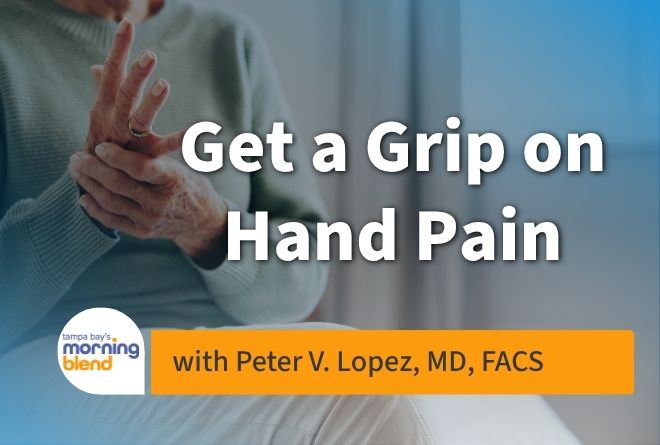
Carpal tunnel syndrome can make even simple tasks feel difficult. At Florida Orthopaedic Institute, Dr. Peter Lopez takes a patient-centered approach to help identify the cause of symptoms and recommend the right treatment plan for each individual. Whether symptoms are mild or interfering with everyday activities, getting evaluated can be an important first step toward relief.
Read more on Tampa Bay’s Morning Blend.
Roxanne: Roxanne Wilder with you and I am at Florida Orthopaedic Institute in Sun City Center. So happy to be joined today by Dr. Peter Lopez. He’s an orthopedic surgeon. Thanks for being here.
Dr. Lopez: Oh, thanks for having us. Thanks for having me.
Roxanne: You know, Dr. Lopez, you are putting me to the test today. We’re talking carpal tunnel and you’ve given me a new word. I’ve never heard of amyloidosis.
Dr. Lopez: Amyloidosis.
Roxanne: And this is something that’s new in the world of medicine in terms of you’ve known that this has existed and now you’re really seeing why this is a problem. Tell us about the amyloid protein. We’ll start there.
Dr. Lopez: Well, amyloidosis amyloid protein is something that’s been around for even more than a century. We’ve known about it. But since the 1800s, we’ve learned about it. We learned about it in medical school. But more recently, it’s become associated with some other conditions.
And one of the specific things that we see in orthopedics as a hand surgeon is carpal tunnel syndrome and trigger finger. And some of the news and information that we have had is that it can actually be found in carpal tunnel and trigger fingers, and we can detect it at a very early stage.
Roxanne: So that detection, that early detection is key. And that’s something specific you do at FOI. When you have a patient come in, you say, all right, let’s take this a step further. Let’s do the biopsy.
Dr. Lopez: Yes. FOI surgeons are specifically trained so that if a patient has a risk factor for amyloidosis, that they can then go ahead and do the treatment, which is taking a small piece of tissue and sending it to the laboratory so we can test it for amyloidosis.
Roxanne: And so you don’t wanna, if you have amyloidosis, you need to get treatment early on. That’s gonna make all the difference in the world. What if you don’t?
Dr. Lopez: Yeah so, absolutely getting it early is is very very key because it’s a very simple treatment something as simple as possibly taking a pill to prevent damage untreated amyloidosis over a period of time we’re talking probably about five to ten years after carpal tunnel syndrome has started can cause heart failure you can get into your heart and it can ultimately cause you to need a heart transplant left untreated.
Roxanne: All the more reason to get that early detection. Now, who might be at risk? Of course, you’ve got the big blanketed group of anyone with carpal tunnel, but are you seeing specific patients that you say, oh, you really need to get this done ASAP?
Dr. Lopez: Yeah, so there are certain risk factors that we look for. It tends to be older patients, not younger patients over the age of 50 to 60. When you have carpal tunnel on both hands, that tends to be a risk factor.
Anyone with any kind of heart abnormality, whether that’s a skipped beat or some sort of conduction, what we call atrial fibrillation problem, anything where the heart has been acting not normal, that would be a risk factor as well.
Trigger fingers, which is a condition we associate with carpal tunnel, is also a risk factor when you have multiple fingers.
Roxanne: It’s so interesting. The human body is amazing. You’re working on hands and realize something going on here could attribute to something happening in your heart.
Dr. Lopez: Absolutely.
Roxanne: And when we pick it up early on, it makes all the difference in the world and we can we can prevent a lot of damage and potentially save a life. Dr. Lopez, my favorite question to ask physicians, what made you decide to go into orthopedics?
Dr. Lopez: Oh, I’ve loved muscle, bones and tendons my whole life. If I didn’t become an orthopedic surgeon, I probably would have been a physical therapist or maybe even a gym teacher. But I’ve always loved movement and the way the body moves and how we get about and use our muscles and tendons to do beautiful things like dancing or athletics. And it’s been a lifelong love of mine.
Roxanne: See, this is why I asked this great answer. That is fascinating. Love talking with you today. And of course, we want you to get back to better. So you see the information on your screen. Go ahead and reach out if you have carpal tunnel, whatever you need to do. Come see Dr. Peter Lopez. We so appreciate your time. Thank you.
Dr. Lopez: Oh, it’s my pleasure. Thank You.
About Florida Orthopaedic Institute
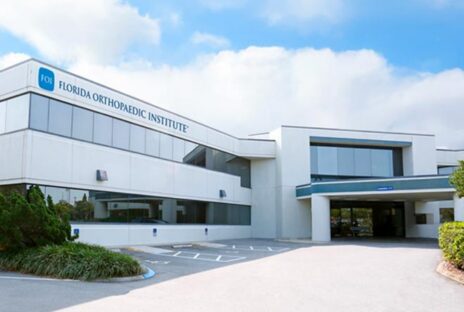
Founded in 1989, Florida Orthopaedic Institute is Florida’s largest physician-led orthopedic group. It provides expertise and treatment of orthopedic-related injuries and conditions, including adult reconstruction and arthritis, foot and ankle, general orthopedics, hand and wrist, orthopedic trauma, shoulder and elbow, spine, interventional pain management, sports medicine, podiatry, physical medicine and rehabilitation, chiropractic services, and physical and occupational therapy, among others. The organization treats patients throughout its surgery centers in North Tampa, South Tampa, and Citrus Park, at several orthopaedic Urgent Care centers and at office locations in Bloomingdale, Brandon, Citrus Park, Gainesville, Lakeland, Northdale, North Tampa, Ocala, Palm Harbor, Riverview, South Tampa, Sun City Center and Wesley Chapel.
May 1, 2026