Advancing the Future of Shoulder Surgery – Dr. Kevin Cronin on Tampa Bay’s Morning Blend
Florida Orthopaedic Institute is proud to highlight a true breakthrough in shoulder surgery. Dr. Kevin Cronin performed the first reported U.S. SCOPE procedure, offering a new treatment option for patients with posterior shoulder instability. By addressing both the soft tissue and the bony anatomy, this procedure may help improve long-term outcomes.
Watch the full video segment to hear Dr. Cronin explain how this innovation is changing the future of shoulder surgery.
Roxanne: A breakthrough in shoulder surgery is giving patients and athletes new hope for recovery. And today, Florida Orthopaedic Institute surgeon, Dr. Kevin Cronin, joins us to talk about the first reported U.S. scope procedure and how this will affect the future of shoulder surgery. So great to have you, Dr. Cronin. How are you today?
Dr. Cronin: I’m doing well. Thanks for having me.
Roxanne: You bet. And of course, I’m excited to hear about this. First time done in the U.S.
Dr. Cronin: Yes.
Roxanne: And you did it?
Dr. Cronin: I did.
Roxanne: Wow
Dr. Cronin: Yeah.
Roxanne: What’s it like? What makes it different?
Dr. Cronin: Well, it’s always exciting when you can bring new technology or procedures to patients here in the community. And this was a really unique opportunity because we’re the first one in the United States to do this procedure.
So this is for patients with posterior instability, tears in the posterior or the back part of their labrum. And we’ve treated these patients for a long time and the results have been mixed. So this is a new procedure that really changes how we approach it and how we think about it.
Roxanne: And what is that change? What makes it different?
Dr. Cronin: So typically what we’ve done is we’ve repaired the soft tissue. So we’ve repaired the labrum, we’ve repaired the tendons and ligaments around the shoulder. And while that has done well initially and patients have been able to get back to sport and get back to life, long term, the results have not been great.
So what this does is it actually addresses not only the labrum and the soft tissues, but it also addresses the bony anatomy. So we changed the structure of the patient’s shoulder and that really has shown much more promising long term results and hopefully preventing arthritis down the road.
Roxanne: Oh, I didn’t even think about the arthritis factor. So not only does it reinforce the procedure, but then you’re not going to have that pain that crops up later on down the line.
Dr. Cronin: Exactly. Not only does it change and help patients in the short term, but I think the huge benefit of this is being able to help them in the long term and change the history of their shoulder.
Roxanne: I see you brought fun props.
Dr. Cronin: We did.
Roxanne: Is there anything I can learn from looking at this?
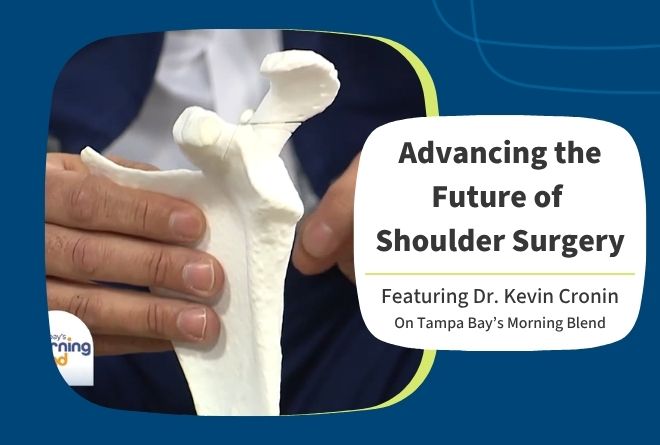
Dr. Cronin: So the most interesting part about this procedure is that it’s specific to every patient. So this is actually a 3D model of one of the patients that we did surgery on. And there are some nuances here, but the anatomy is not quite right.
So the patient gets a CAT scan. We send it off. We work really closely with the engineers in Switzerland and we’re able to develop a precise plan and we print these guides here and that helps us work during surgery to correct the patient’s anatomy in a very precise position.
Roxanne: This technology is crazy, isn’t it? What about for specific patients? Who does it benefit most? I know it’s regular people like myself, but also athletes.
Dr. Cronin: So young athletes, a lot of patients who’ve had other procedures done on their shoulder and are still having issues getting back to sport or getting back to life, patients with posterior instability will typically have pain in the back part of their shoulder or a feeling of looseness when lifting their arm up overhead or trying to do activities.
Roxanne: Very cool. Okay, Dr. Cronin, I’d love to ask doctors this. You guys know that. I love this question. What made you decide to go in this particular direction in terms of medicine, this field?
Dr. Cronin: Well, shoulder surgery is very interesting because it’s so vast. My practice is very varied. I take care of young athletes with complex problems. I take care of young baseball players and their teens and I take care of people in their 70s or 80s with shoulder arthritis. So it really lets me run the gamut of taking care of the whole community.
Roxanne: Oh, that must be a good feeling.
Dr. Cronin: It is. It’s really nice to be able to do what we do and people come in with a problem and we get them back to doing the things that they want to do.
Roxanne: And so we just love you being here explaining all this. It’s fascinating and it’s really exciting that you’re the first doctor in the United States to do this. So congratulations.
We want to share that information with our viewers. Of course, it speaks to the talent that you have at Florida Orthopaedic Institute. And there you go. Florida Ortho dot com is the website to go to get built for better at Florida Orthopaedic Institute. Thank you so much for your time today.
Dr. Cronin: Thank you for having me.
About Florida Orthopaedic Institute
Founded in 1989, Florida Orthopaedic Institute is Florida’s largest physician-led orthopedic group. It provides expertise and treatment of orthopedic-related injuries and conditions, including adult reconstruction and arthritis, foot and ankle, general orthopedics, hand and wrist, orthopedic trauma, shoulder and elbow, spine, interventional pain management, sports medicine, podiatry, physical medicine and rehabilitation, chiropractic services, and physical and occupational therapy, among others. The organization treats patients throughout its surgery centers in North Tampa, South Tampa, and Citrus Park, at several orthopaedic Urgent Care centers and at office locations in Bloomingdale, Brandon, Citrus Park, Gainesville, Lakeland, Northdale, North Tampa, Ocala, Palm Harbor, Riverview, South Tampa, Sun City Center and Wesley Chapel.
May 28, 2026