Game-Changing Technology for Thumb Arthritis – Dr. Devin Collins on Tampa Bay Morning Blend
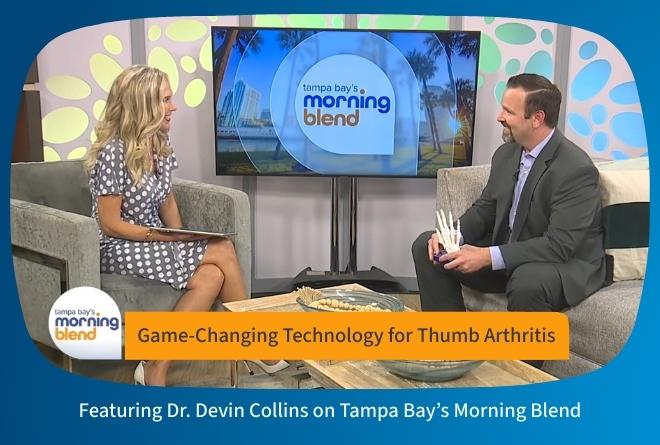
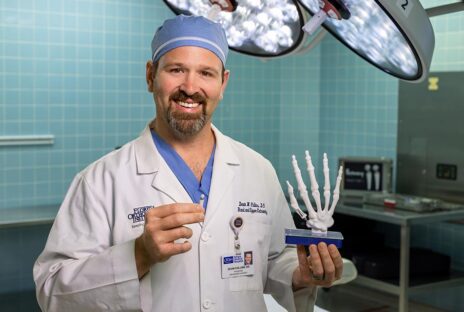
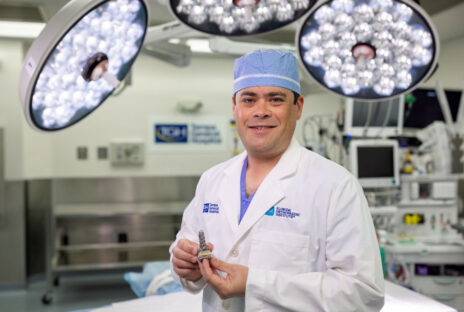
In this interview, Devin W. Collins, DO, discusses how this innovative joint replacement can help patients suffering from painful thumb arthritis regain strength, mobility, and quality of life when other treatments are no longer effective. Unlike traditional procedures that remove bone and rely on scar tissue, the TOUCH CMC prosthesis replaces the damaged joint with a dual-mobility implant designed to restore natural movement and stability in the thumb. This milestone reflects the continued commitment to clinical innovation and collaboration that expands access to advanced treatments for patients across Florida and beyond.
Natalie: Some arthritis can make everyday activities like opening a jar, gripping a golf club, typing, even turning a doorknob painful and limiting. Patients who once faced chronic pain and reduced mobility now have a new option. It’s a major milestone in hand surgery innovation and can help those affected return to the activities they love with greater comfort and confidence. Dr. Devin Collins from the Florida Orthopaedic Institute is here with more. Welcome, doctor. How you doing?
Dr. Collins: I’m doing great. Thanks for having us out.
Natalie: Well, let’s go ahead, jump right in. First in Florida to get this procedure done. Introduce us. Tell us about it.
Dr. Collins: Yeah, absolutely. We’re super excited about this. So this implant, it’s been in Europe for a number of years, but we’re excited that it’s now in the U.S. We’re able to be the first institution in Florida to put it in. Essentially, patients that are suffering with thumb CMC arthritis, so pain when they’re kind of twisting objects, we’re able to now offer them an implant that restores the mobility. And so instead of taking out the bone like we used to do, we’re able to preserve the bone, maintain length to get them back quicker to activities.
Natalie: Well, and give us an idea too, game-changing technology, I know, being able to do that. But you say, you know, being able to keep the bone in there, I feel like that’s going to be more of a benefit to the patient all around. Is that true?
Dr. Collins: Yes, absolutely. Yeah. So I like to think of this as a mini total hip. So it’s like a total hip, but for the hand, essentially. So we’re basically taking out the arthritis and we’re putting in an implant in there so they can start moving a little bit quicker.
Natalie: Well, and let’s talk too about the focus of patient care. I know that’s first and foremost for you as I’ve gotten to know you guys through the years. Are these patients maybe didn’t have success with other treatments and now this standard of care is being able to increase and be able to help more patients? And maybe if they thought, I got to live with this now, that’s going to be the difference maker.
Dr. Collins: Yeah, absolutely. So, you know, our old way of doing, I shouldn’t say old way, but we used to take out the bone and suspend it. So this just allows patients to kind of get moving a little bit quicker, essentially.
Natalie: And again, that’s a win-win for everybody, right? Do you have the ideal candidate that you’re looking for? Are there those people that really should, you know, maybe have that one thing that’s like, oh, if this is a struggle for you, this may be a good solution.
Dr. Collins: Yeah, absolutely. So we always start with conservative treatments. So patients that have this thumb seam arthritis, pain with twisting objects, pain in the thumb and the wrist region, if they’ve had injections, braces, and they’re refractory to that, so they keep having pain, this may be a great option for them.
Natalie: And then of course, you know, getting back to how this is able to improve the patient’s life. What about being able to give them longevity? I’m assuming that once this is done, there’s no turning back then, right? It’s a win-win.
Dr. Collins: Yeah, I mean, absolutely. So once they have this in, the goal is to get people back to doing the things that they love. If they love to golf, they love to play pickleball, tennis, getting them back to doing just everyday activities.
Natalie: I like it. And again, making that analogy to the hip surgery, which is something that we’ve talked about on the show, is a win-win as well, isn’t it?
Dr. Collins: Absolutely. Yes, ma’am.
Natalie: Okay. Well, anything else you’d like to leave with our viewers who maybe this is hitting home? Maybe they’re starting to realize that, oh, those injections didn’t work when it comes to my thumb?
Dr. Collins: Yeah, I would say that. Again, yeah. If the injections stop working, the braces stop working, come in and see us. We’re happy to evaluate it, take a look at it, and then you may be a great candidate for this.
Natalie: Well, you know what? I just want to reiterate that one more time, of course. So patients experiencing persistent thumb or wrist pain, you know what? You don’t have to live with those limitations.Early evaluation can help determine whether those innovative treatments like the thumb joint replacement may be appropriate. To learn more or schedule a consultation with a hand and wrist specialist, patients are encouraged to call, request an appointment today. Get back to better.
About Florida Orthopaedic Institute
Founded in 1989, Florida Orthopaedic Institute is Florida’s largest physician-led orthopedic group. It provides expertise and treatment of orthopedic-related injuries and conditions, including adult reconstruction and arthritis, foot and ankle, general orthopedics, hand and wrist, orthopedic trauma, shoulder and elbow, spine, interventional pain management, sports medicine, podiatry, physical medicine and rehabilitation, chiropractic services, and physical and occupational therapy, among others. The organization treats patients throughout its surgery centers in North Tampa, South Tampa, and Citrus Park, at several orthopaedic Urgent Care centers and at office locations in Bloomingdale, Brandon, Citrus Park, Gainesville, Lakeland, Northdale, North Tampa, Ocala, Palm Harbor, Riverview, South Tampa, Sun City Center and Wesley Chapel.
March 16, 2026